What to Expect at Laniakea Beach
Expect a beautiful, lightly developed North Shore shoreline, a short and sometimes awkward arrival, very limited facilities and a possible Hawaiian green sea turtle sighting that can never be guaranteed.


The realistic version
Laniakea Beach is best treated as a flexible wildlife and scenery stop, not as a guaranteed turtle attraction or a fully equipped beach park. It can become one of the most memorable moments of a North Shore day, but only when you are comfortable with limited parking, uneven terrain, changing ocean conditions and the possibility of seeing no turtle at all.
The biggest source of disappointment at Laniakea is usually not the beach itself. It is the gap between social-media expectations and the actual visit. There is no entrance gate, ticket booth, visitor center or staged wildlife experience. You arrive beside Kamehameha Highway, find a legal place to leave the vehicle, follow the current pedestrian route and scan a natural shoreline where protected wildlife may or may not be visible.
Know this before you build the stop into your day
The access and parking area has been affected by a long-running highway drainage and safety project. Official updates still do not provide one simple final-opening notice for every completed feature. Use the current legal layout, posted signs and marked pedestrian route you find when you arrive. An old photo or travel video may show a different configuration.
Is Laniakea the right stop for you?
Choose Laniakea if
You value wildlife observation, can handle a short walk over imperfect surfaces, accept that nature is unpredictable and are willing to leave if parking or crowd conditions are poor.
Skip it if
You need guaranteed wildlife, easy swimming, public restrooms, a firm accessible route, abundant shade or a simple place for young children to spend several hours.
What the arrival actually feels like
Laniakea does not announce itself like a major attraction. The first things you notice may be traffic, vehicles moving through the access area, temporary-looking barriers or other visitors trying to orient themselves. Slow down mentally, but never slow or stop in an active travel lane to search for a space.
Once legally parked, secure the vehicle, leave valuables out of sight and take only what you can comfortably carry. Follow current signs and any marked pedestrian path. Keep children beside an adult and put phones away whenever your route comes close to traffic. If a volunteer, police officer, flagger or construction worker gives an instruction, follow it immediately.
- Park only where currently permitted Do not improvise a space, block access or wait in the highway for another vehicle to leave.
- Follow the designated walking route Use the path, bridge or crossing arrangement shown by current signs and barriers.
- Pause and scan the shoreline Look for volunteer boundaries, resting turtles and the reach of the waves before choosing where to stand.
- Observe without changing the scene Keep at least 10 feet from turtles, use zoom for photographs and never block an animal’s path.
- Leave the area as you found it Carry out waste and continue your itinerary if conditions are crowded, unsafe or uncomfortable.
For route-specific planning, use the Directions to Laniakea Beach and Laniakea Beach Parking and Access guides.


What the beach itself is like
The shoreline is a mixture of sand, exposed rock, reef and shallow nearshore habitat. The amount of open sand changes with tide, waves and season. A carefully framed photograph may make the beach look broad and obstacle-free, but first-time visitors should expect a more varied surface.
| What you may notice | What it means for your visit |
|---|---|
| Uneven sand and rocks | Wear secure footwear and move slowly, especially with children or limited mobility. |
| Small gathering around one area | A turtle may be present. Stop at the outer edge and identify the viewing boundary before moving closer. |
| Little natural shade | Bring water and sun protection, even for a short stop. |
| Waves reaching farther up the sand | Keep bags, children and your viewing position above the active wave zone. |
| No obvious amenity area | Use restrooms and buy drinks before arriving. |
The beach can feel peaceful when visitor numbers are low, but it can change quickly. One turtle appearing on the sand may draw a cluster of people within minutes. Leave room for other visitors, avoid surrounding the animal and step away once you have had a clear look.
What to expect from the turtles
Hawaiian green sea turtles, known locally as honu, use the nearshore habitat around Laniakea for feeding and may come onto the beach to rest. Basking is normal behavior. A turtle can remain almost completely still for a long time, and a motionless animal is not automatically in distress.
You might see several turtles on the sand, one turtle moving through shallow water, only a head or shell offshore, or no turtle at all. There is no public feeding, release or appearance schedule. Time of day and season can shape your chances, but neither creates a promise.
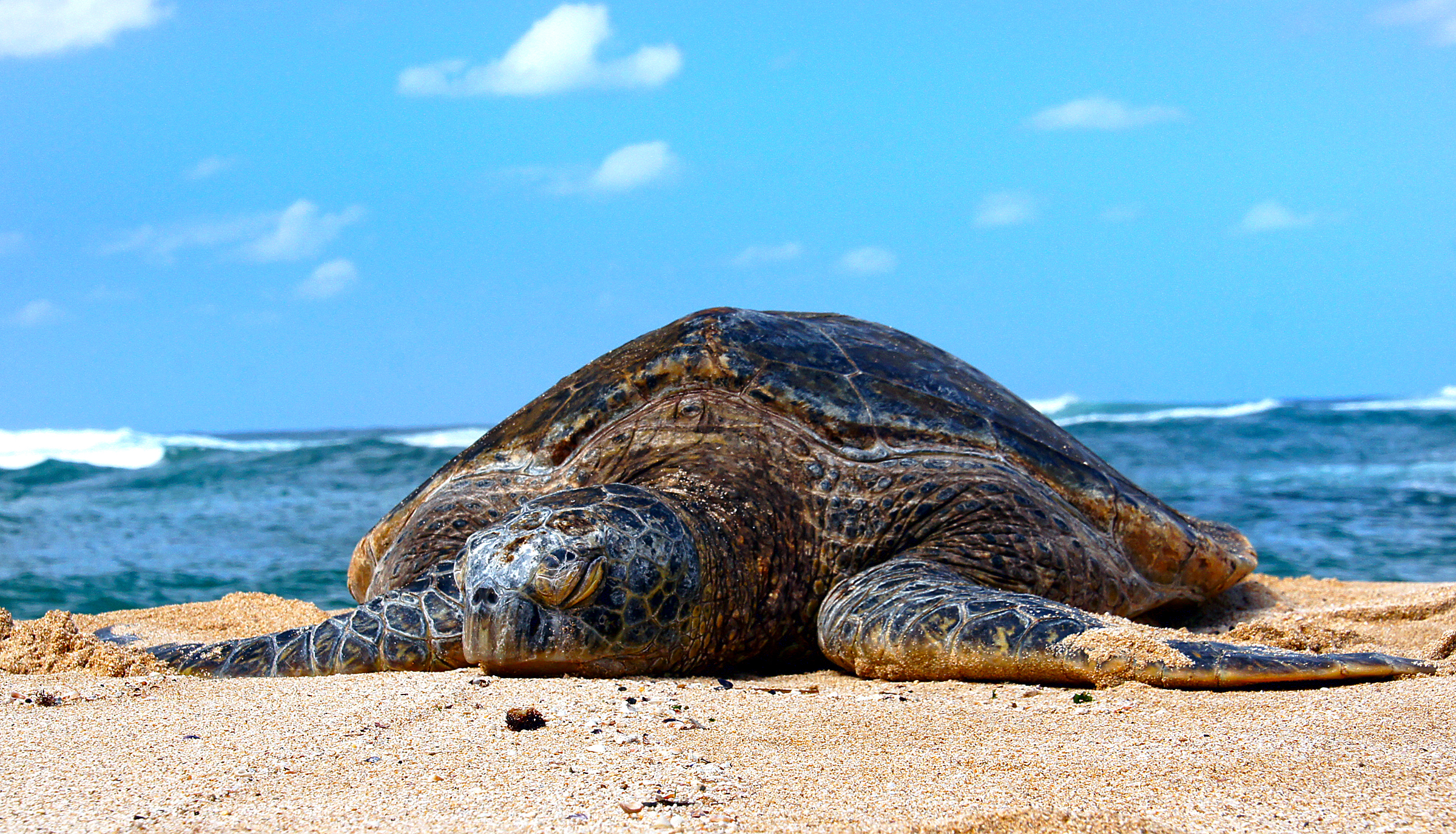

Keep at least 10 feet away
NOAA Fisheries recommends staying at least 10 feet, or 3 metres, from sea turtles both on land and in the water. A rope, sign, volunteer or official may establish a larger boundary. In that case, the larger distance is the one to follow.
- Never touch, feed, chase or attempt to pose with a turtle.
- Do not stand between a turtle and the ocean.
- Keep children and pets under close control.
- Use the zoom on your phone or camera instead of stepping closer.
- Keep voices low and avoid sudden movement near resting wildlife.
- Do not enter the water simply because a turtle is visible offshore.
Read the Laniakea Turtle Viewing Guide and Sea Turtle Safety Rules before your visit.
Will turtle volunteers be there?
Community volunteers have a long history of monitoring turtles, creating viewing boundaries and helping visitors understand honu behavior at Laniakea. Their presence is valuable, but it should not be treated as a guaranteed visitor service.
If a volunteer is present, respect the boundary and ask concise questions without interrupting active wildlife protection. If nobody is present, the same rules still apply. Visitors remain responsible for maintaining distance, keeping the route to the ocean clear and avoiding any disturbance.


Facilities, shade and what to bring
Laniakea should not be planned as a developed beach park. Do not count on public restrooms, showers, changing rooms, food vendors, equipment rental or a visitor center at the beach. Haleiwa is the most practical place to use facilities, buy water and organize the next part of your day before you continue north.
Useful essentials
- Drinking water
- Hat and sun protection
- Secure shoes or sandals
- Phone or camera with zoom
- A small bag for your waste
- Essential child or medical supplies
Unhelpful expectations
- A guaranteed turtle photograph
- Equipment for a fully serviced beach day
- Food intended for wildlife
- A schedule with no room for traffic
- The assumption that old access videos are current
- Anything you cannot carry back out
Natural shade can be limited, and reflected light from the sand and water can make a short midday stop feel hotter than expected. Protect small children from prolonged sun exposure. Do not place chairs, umbrellas, bags or strollers inside a wildlife boundary or on a turtle’s route.
What to expect from the ocean
North Shore conditions can change sharply by season and swell. May through October is generally the smaller-surf season on north-facing shores. November through April can bring extremely high, powerful surf. Even in summer, local waves, reef, current and wind can make a particular entry unsuitable.
Laniakea is not the strongest all-purpose swimming choice for a first-time visitor. The shoreline includes rock and reef, the main reason to visit is wildlife observation, and you should not assume active lifeguard coverage at the point where you are standing. When the water looks uncertain, stay on land.


Turtle viewing never requires entering the water
Do not swim toward a turtle or step onto wet rocks to improve a photograph. Stay ashore whenever waves, rock, current, visibility or your own ability create uncertainty. Choose a lifeguarded beach for swimming when that is the main purpose of your day.
Crowds, photography and visitor behavior
A visible turtle can turn a quiet section of sand into a busy viewing area. You may encounter independent travelers, families and organized tour groups making brief stops. Their behavior is not a reliable guide to the correct distance.
Stop at the outside of the group, identify the turtle and any existing boundary, then choose a position that does not close the animal in. Take a few photographs, lower your camera and allow others a clear view. If people are too close for you to maintain the recommended distance, wait farther back or leave.
- Do not step over a rope because somebody else has done so.
- Avoid flash, loud calls and attempts to make the turtle move.
- Never ask a child to stand close to an animal for scale.
- Do not block the shoreline while reviewing photos.
- Respect residents, private property and other beach users.
Visiting with children
Children can find the encounter fascinating, but the visit needs more adult attention than a normal sightseeing stop. The combination of highway traffic, uneven ground, sun, waves and protected wildlife makes close supervision essential.
Before arrival, explain that a turtle may not appear, touching and feeding are not allowed, the stop may be brief and another beach will be used for restrooms or swimming. Keep one adult focused on the children while another handles directions, photographs or bags. A stroller may be awkward on soft sand and uneven shoreline, so consider whether a carrier is more practical for a very young child.
Accessibility and limited mobility
Laniakea can be challenging for visitors who need a firm, predictable surface. The exact route from a legal parking space to the viewing area can depend on the current access configuration, and the beach itself includes soft sand and rock. Shade, seating and nearby accessible restroom facilities should not be assumed.
If anyone in your group needs step-free access, minimal walking or a reliably paved viewing area, review current access information immediately before departure. Be prepared to choose a developed beach park or another organized wildlife experience if the live arrangement does not meet the person’s needs. See Facilities and Accessibility at Laniakea Beach for a fuller decision guide.
How long should you plan to stay?
| Visit style | Useful planning time | Best approach |
|---|---|---|
| Quick scenery stop | 20 to 30 minutes after parking | Walk to the shoreline, scan the area and continue without waiting for wildlife. |
| First turtle-viewing visit | 30 to 60 minutes after parking | Allow time to orient yourself and wait briefly, but accept that no turtle may appear. |
| Long beach stay | Condition-dependent | Possible, but another beach is usually more practical for facilities, shade and swimming. |
| Organized tour stop | Set by the operator | Expect a shorter stop and follow both the guide’s timing and wildlife rules. |
Parking and North Shore traffic are not included in these estimates. Avoid placing a fixed reservation immediately after the visit. A flexible plan makes it easier to skip Laniakea safely if there is no legal space or to stay a little longer when conditions are excellent.
A simple first-visit plan
- Check current roadwork, access, weather and North Shore surf information.
- Use a restroom and buy water before leaving Haleiwa or another developed stop.
- Allow extra time for traffic without building your day around a turtle sighting.
- Park only in a currently legal space and follow the marked pedestrian route.
- Scan the beach before moving toward a crowd or the waterline.
- Stay at least 10 feet from every turtle and behind all larger boundaries.
- Keep the viewing area quiet and the route between wildlife and ocean open.
- Leave after 30 to 60 minutes, or sooner if heat, surf, crowds or access feel unsafe.
- Continue to a better-equipped North Shore beach for swimming, restrooms or a longer stay.
Is Laniakea Beach worth visiting?
Yes, when your priority is a respectful chance to observe honu in a natural coastal setting and you accept the practical compromises. The experience can be moving precisely because it is not staged. You are watching a wild animal choose to feed, swim or rest in its own habitat.
It is reasonable to skip the stop when safe parking is unavailable, the shoreline is too crowded to maintain distance, winter surf is severe, your group needs developed facilities or your itinerary depends on a guaranteed result. Choosing a beach that better fits your group is not missing out. It is good trip planning.
Sources and verification
Wildlife distance and behavior guidance was checked against NOAA Fisheries. Seasonal surf guidance was checked against Hawaii Ocean Safety. Parking and access wording remains intentionally cautious because the official Laniakea project record shows continuing work and progress updates, but does not present one clear final notice that every planned visitor feature is fully open in its permanent configuration.
- NOAA Fisheries: Viewing Marine Wildlife in Hawaii
- NOAA Fisheries: Sea Turtle Questions for the Pacific Islands
- Hawaii Ocean Safety: Hawaii’s Surf Seasons
- Laniakea Highway and Pedestrian Safety Project: Progress Updates
- Hawaii Department of Transportation: Oahu Roadwork
Frequently asked questions
Are turtles guaranteed at Laniakea Beach?
No. Honu regularly use the area, but they are wild animals and no particular sighting, number or time can be guaranteed.
How close can I get to a turtle?
NOAA Fisheries recommends staying at least 10 feet, or 3 metres, away on land and in the water. Stay behind any larger boundary created by signs, rope, volunteers or officials.
Are there restrooms or showers?
Do not plan on public restrooms, showers or changing rooms at the beach. Use facilities before arrival and choose a developed beach park when amenities are essential.
Is parking easy?
No. Availability can be limited and the layout has been affected by a major highway safety project. Use only the current legal arrangement and leave if a safe space is not available.
Is Laniakea a good swimming beach?
Swimming depends on the day, but rock, reef and seasonal North Shore surf make it less predictable than a protected sandy beach. Stay out whenever conditions or your ability create uncertainty.
Is it suitable for small children?
It can be a rewarding short wildlife stop with very close adult supervision. Traffic, sun, uneven terrain, waves, limited facilities and wildlife distance make it less convenient for a long family beach day.
How long should a first visit take?
Allow 30 to 60 minutes after parking. Add extra time for North Shore traffic and the walk from the current legal parking area.
What happens if no turtle appears?
Enjoy the coastal view briefly and continue your North Shore itinerary. Waiting longer still does not guarantee a sighting.
Continue planning your visit
Use the practical guides that answer the questions most likely to affect your Laniakea stop.